
Last Updated on October 6, 2026 by Ellen Christian
Almost everyone has a junk drawer. It starts out holding a few useful things like scissors, batteries, pens, and tape. Before long, it becomes the place where anything without an obvious home gets tossed.
Posts may be sponsored. This post contains affiliate links, which means I will make a commission at no extra cost to you should you click through and make a purchase. As an Amazon Associate I earn from qualifying purchases.
Eventually, you can barely open the drawer without something getting stuck.
If your first instinct is to buy a set of drawer organizers, wait. You may not need them. In fact, adding organizers before you declutter can make the problem worse because you’re simply finding better ways to store things you don’t actually need.
Here’s how to declutter a junk drawer using what you already have and create a simple system that’s easy to maintain.
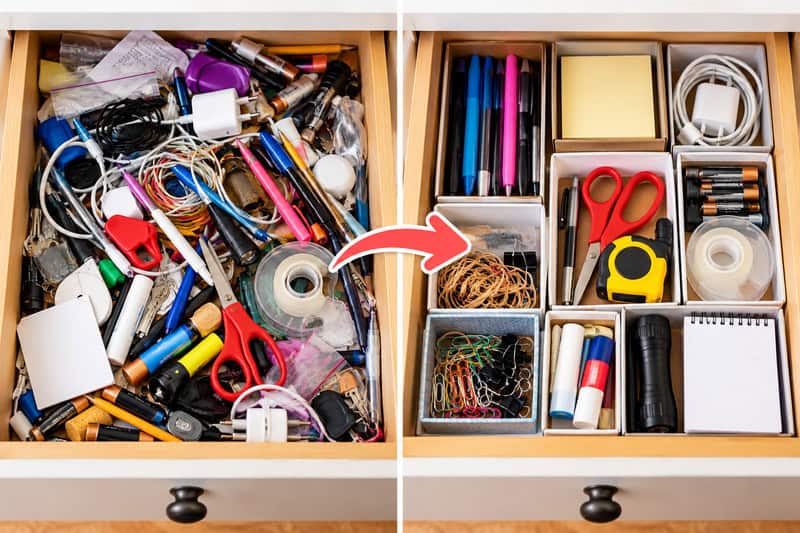
Empty the Entire Junk Drawer
This is one situation where I recommend taking everything out at once.
A junk drawer is usually small enough that you can finish it in one sitting, and it’s difficult to see how much unnecessary stuff is hiding inside until you empty it.
Put everything on the kitchen table or counter.
While the drawer is empty, wipe out the crumbs, dust, and little bits of debris that always seem to collect in the corners.
Don’t start putting things back yet.
Throw Away the Obvious Trash First
Start with the easiest decisions.
Look for things like:
- Dried-out pens and markers
- Empty tape dispensers
- Expired coupons
- Old receipts you don’t need
- Broken rubber bands
- Scraps of paper
- Empty packages
- Broken items
- Batteries that no longer work
- Mystery pieces you haven’t identified in years
Getting rid of obvious trash immediately makes the pile much less overwhelming.
You don’t need to make difficult decisions yet. Just remove the things you know you don’t need.
Take Out Things That Belong Somewhere Else
A junk drawer often becomes cluttered because it’s convenient.
Instead of walking across the house to put something away, we toss it into the nearest drawer.
Look through what’s left and remove anything that already has another home.
Maybe the screwdriver belongs with your tools. Hair ties belong in the bathroom. Coins belong in your change jar. Sewing supplies belong with your sewing things.
Don’t create a new home for something when it already has one.
I like to put these items into a small basket or container while I’m decluttering. When I’m finished with the drawer, I can walk through the house once and put everything where it belongs.
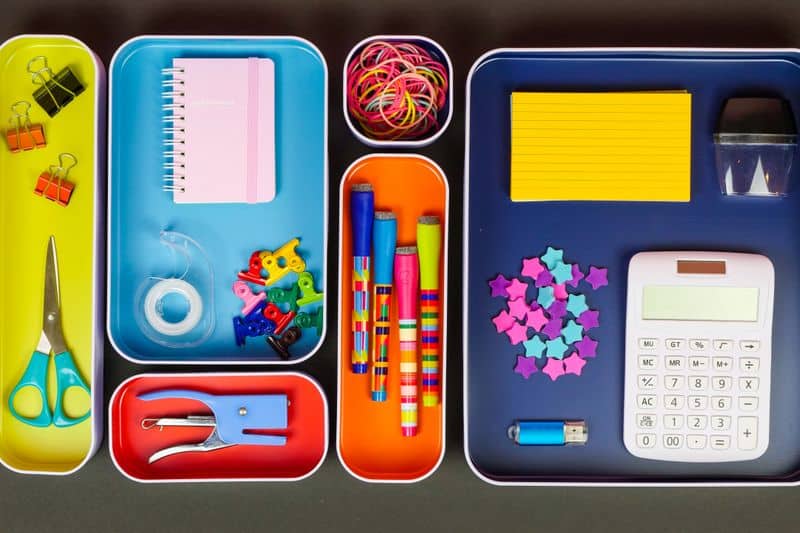
Decide What Your Junk Drawer Is Actually For
This step can make a huge difference.
Instead of allowing your junk drawer to hold absolutely anything, decide what kinds of things deserve space there.
For example, your drawer might contain:
- Pens and pencils
- Scissors
- Tape
- A small notepad
- Batteries
- Flashlight
- Measuring tape
- A few frequently used household tools
Your list may look completely different.
The point isn’t to create a perfect Pinterest-worthy drawer. It’s to give the drawer a purpose.
If you know what belongs there, it becomes much easier to recognize what doesn’t.
Be Realistic About How Many You Need
Duplicates can quickly take over a small drawer.
You might need two or three pens. You probably don’t need 27.
The same goes for pencils, scissors, tape measures, takeout menus, notepads, charging cords, and all the other little things that tend to multiply.
Keep your favorites and the ones you actually use.
Move useful extras to a more appropriate storage area or let them go.
This is similar to the One-In, One-Out Rule I use in other areas of my home. Setting limits keeps a space from slowly filling back up again.
Internal link: Link One-In, One-Out Rule to your existing article.
Don’t Keep Mystery Items Forever
This is one of my weaknesses.
You find a tiny piece of plastic or a strange screw and think, This must belong to something important.
So you put it back.
Three years later, it’s still sitting there and you still don’t know what it belongs to.
Give yourself permission to let go of mystery objects you’ve been saving indefinitely.
If you’ve had an unidentified piece in the junk drawer for years and nothing in your home has fallen apart without it, there’s a good chance you don’t need to keep storing it.
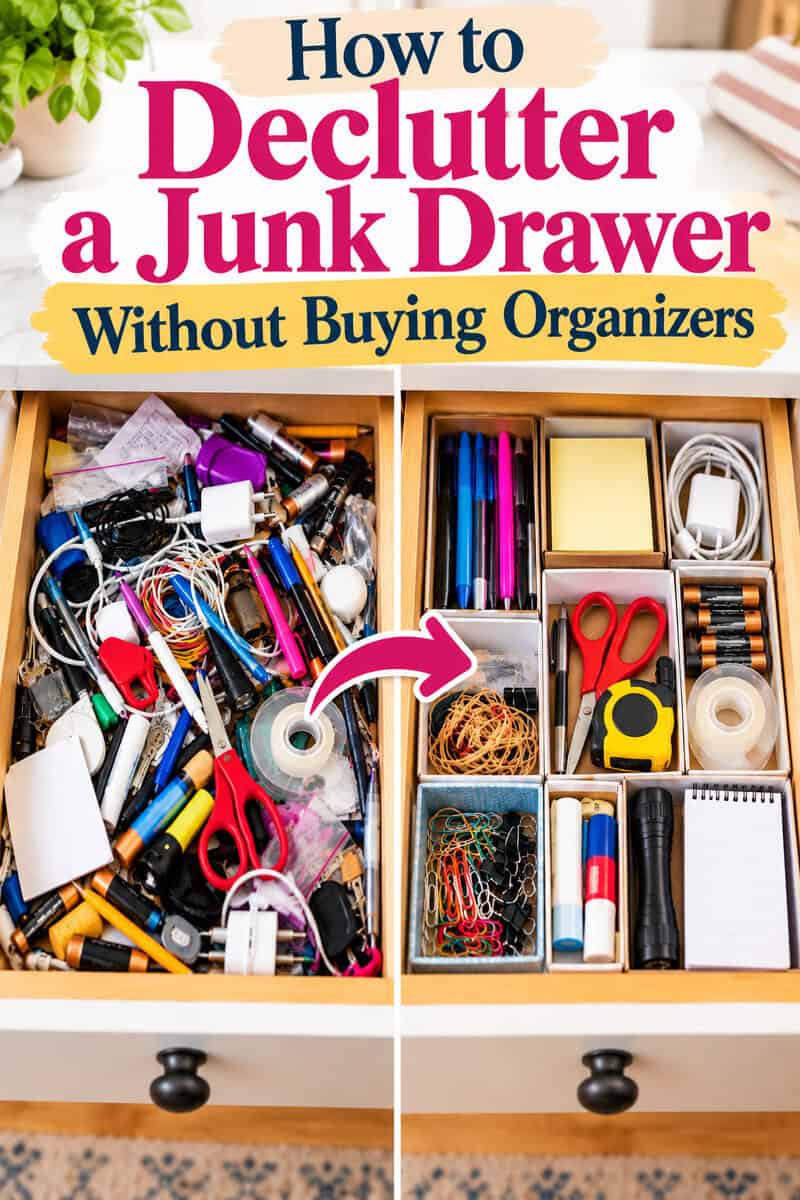
Use What You Already Have to Separate Small Items
Once you’ve decided what deserves to stay, you can think about organization.
But don’t go shopping yet.
Look around your house for small containers you already have.
You might be able to reuse:
- Small cardboard boxes
- Checkbook boxes
- Jewelry boxes
- Small food storage containers without lids
- Clean jar lids
- Small baskets
- Gift boxes
- Empty phone boxes
- Sturdy product packaging
Small cardboard boxes are especially useful because you can trim them down if they’re too tall for the drawer.
Arrange a few containers inside the drawer and use them to separate categories.
One might hold pens and pencils. Another might hold batteries. A smaller one could contain rubber bands or paper clips.
It doesn’t matter if the containers match.
Once the drawer is closed, nobody sees them anyway.
Leave Some Empty Space
Don’t try to fill every inch.
A little empty space makes the drawer easier to use.
If every container is packed tightly together and every compartment is overflowing, you’ve probably kept too much.
You should be able to open the drawer easily, see what you have, and remove something without shifting five other things.
Empty space isn’t wasted space.
It’s what keeps an organized drawer functional.
Don’t Turn the Junk Drawer Into a Storage Solution
There’s an important difference between a useful junk drawer and a drawer where you hide clutter.
If something doesn’t have a home, don’t automatically decide that the junk drawer is its home.
Ask yourself:
Do I use this?
If yes, decide where it logically belongs.
If no, you probably don’t need to find a place to store it.
This is one of the biggest lessons I’ve learned from decluttering. Sometimes the answer isn’t another basket, bin, shelf, or organizer.
Sometimes the answer is simply owning less.
Create a Five-Minute Junk Drawer Reset
Once you’ve decluttered the drawer, maintaining it should be easy.
Every month or two, spend five minutes checking it.
Throw away trash.
Return misplaced items to their proper homes.
Test questionable pens.
Remove things you haven’t used.
Straighten the small containers you’re using as dividers.
You don’t need to empty the entire drawer every time. A quick reset prevents it from reaching the point where you have to start over.
What If the Drawer Starts Overflowing Again?
Treat an overflowing drawer as a signal.
It doesn’t necessarily mean you need another drawer or a bigger organizer.
It probably means it’s time to declutter again.
Before finding more storage, look at what’s accumulating.
Have extra pens appeared? Are receipts piling up? Did someone start tossing charging cords into the drawer? Are there things that belong somewhere else?
Remove the excess instead of expanding the storage.
The goal is to make your home easier to manage, not continually create more places to put things.
A Junk Drawer Doesn’t Have to Be Perfect
Your junk drawer doesn’t need matching bamboo dividers or beautifully printed labels.
It just needs to work.
Keep the things you actually use, get rid of the things you don’t, return misplaced items to their proper homes, and use containers you already own to keep the remaining items under control.
You may discover that once you’ve decluttered properly, you don’t need to buy an organizer at all.
And that’s one less thing coming into your home.
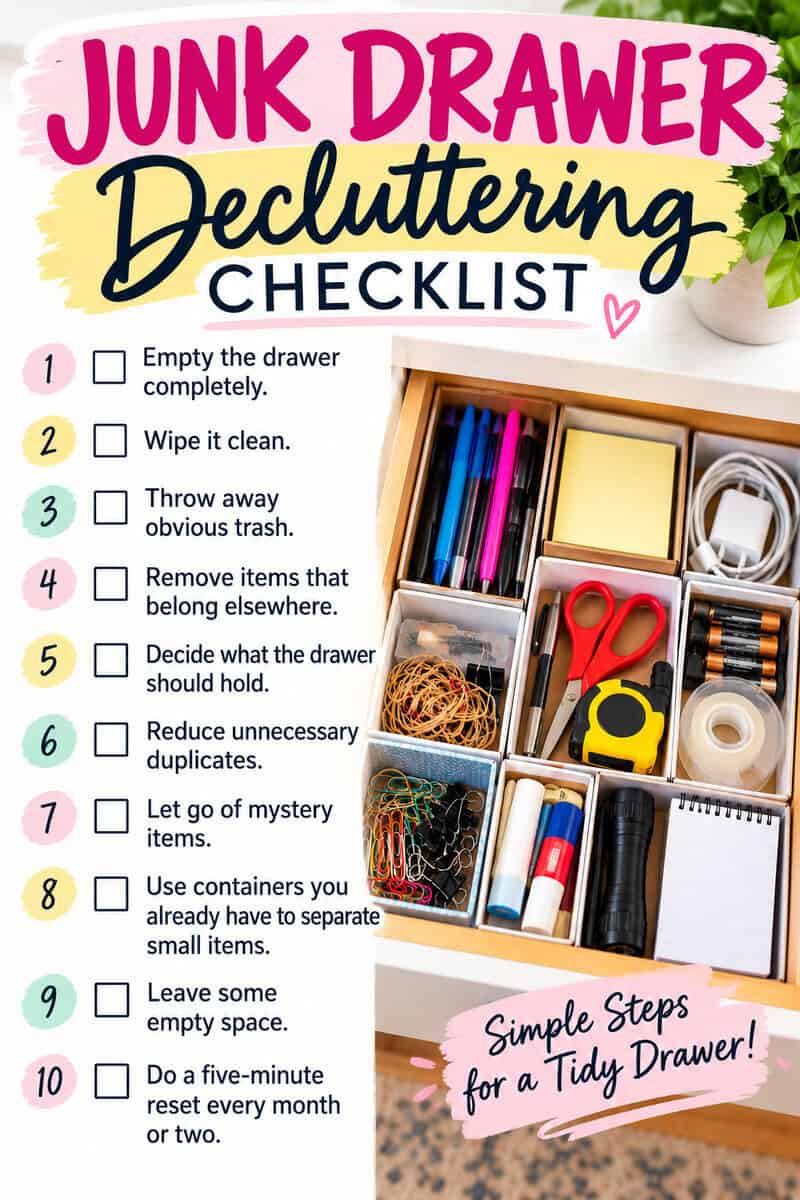
Quick Junk Drawer Decluttering Checklist
- Empty the drawer.
- Wipe it clean.
- Throw away obvious trash.
- Remove things that belong elsewhere.
- Decide what the drawer should hold.
- Reduce unnecessary duplicates.
- Let go of mystery items.
- Separate small items with containers you already own.
- Leave some empty space.
- Do a five-minute reset every month or two.

Ellen is a busy mom of a 29-year-old son and 33-year-old daughter. She owns nine blogs and is addicted to social media. She believes that it doesn’t have to be difficult to lead a healthy life. She shares simple healthy living tips to show busy women how to lead fulfilling lives. If you’d like to work together, email info@confessionsofanover-workedmom.com to chat.
