
Last Updated on May 28, 2026 by Ellen Christian
The best tools for dementia caregivers include purpose-built GPS wearables for wandering prevention, smart home safety sensors that monitor hazards, automated medication management systems to prevent dosing errors, and simplified video calling devices for reliable remote check-ins.
Posts may be sponsored. This post contains affiliate links, which means I will make a commission at no extra cost to you should you click through and make a purchase. As an Amazon Associate I earn from qualifying purchases.
These practical dementia caregiver technology tools replace the exhaustion of constant manual vigilance with reliable support systems.
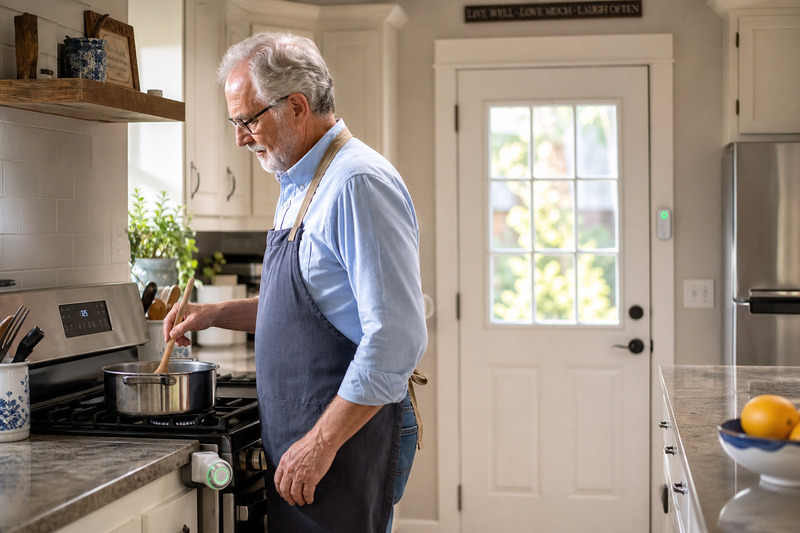
By reducing daily safety risks, they make home care significantly more manageable for families.
Dementia caregiving sits at a rare intersection. It is one of the most emotionally demanding roles a person takes on, while simultaneously being one of the most logistically complex.
Yet, many family caregivers are still managing this profound responsibility with the same tools available a decade ago, like scattered phone calls and handwritten notes.
Fortunately, a purposeful set of technologies now exists that can meaningfully reduce both the safety risks and the cognitive load that this role demands.
1. Best Devices to Prevent Unsafe Wandering
Early to mid-stage dementia is where the risk of wandering is most acute, but it is also the stage where independent living at home remains a realistic goal worth protecting.
About 80% of adults with Alzheimer’s disease and related dementias receive care in their homes, making independence a priority.
When trying to maintain this independence, the obvious solution often fails because smartphones are easily misplaced and require active engagement.
That assumption becomes increasingly unreliable as cognitive decline progresses.
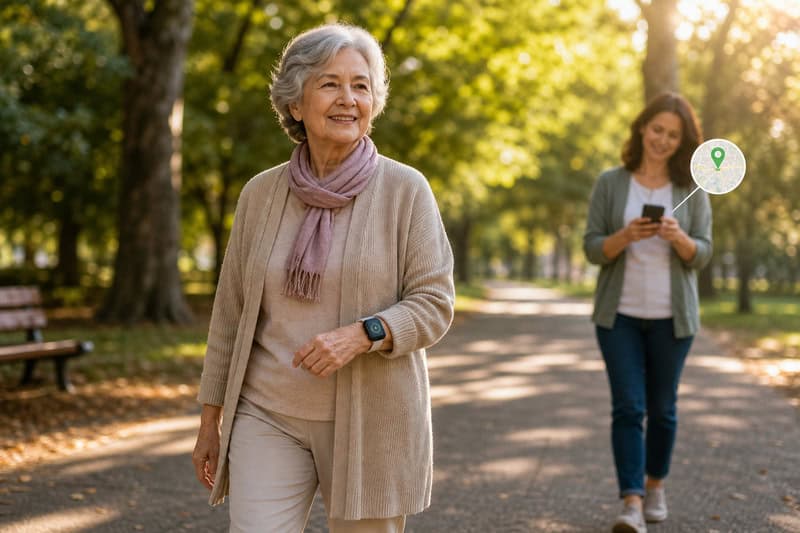
Instead, a purpose-built GPS tracker for dementia patient safety, worn comfortably on the wrist, becomes a seamless part of the daily routine rather than an added responsibility.
It works for the wearer without requiring anything from them. For example, a well-designed GPS-enabled dementia watch from Tranquil combines real-time location tracking and two-way calling.
Because it is styled like a luxury timepiece and features full waterproof durability, a loved one is far more likely to wear it consistently.
Setup typically involves a subscription plan and brief app onboarding, often supported by live human assistance. However, it is important to set realistic expectations for any device.
A GPS wearable does not physically prevent a loved one from wandering. Rather, it enables an immediate and informed response when they do leave the home.
| Key Insight: A smartphone requires the user to recognize disorientation and initiate help. A purpose-built GPS watch removes that demand entirely, working for your loved one without requiring anything from them. |
2. Passive Smart Home Safety Sensor Solutions
One of the most draining dimensions of caregiving is the feeling that a physical accident is always one unobserved moment away.
Over 11 million U.S. adults provide unpaid care for someone with a form of dementia, often carrying this mental load alone.
Caregivers frequently feel they must be present everywhere to prevent what could go wrong.
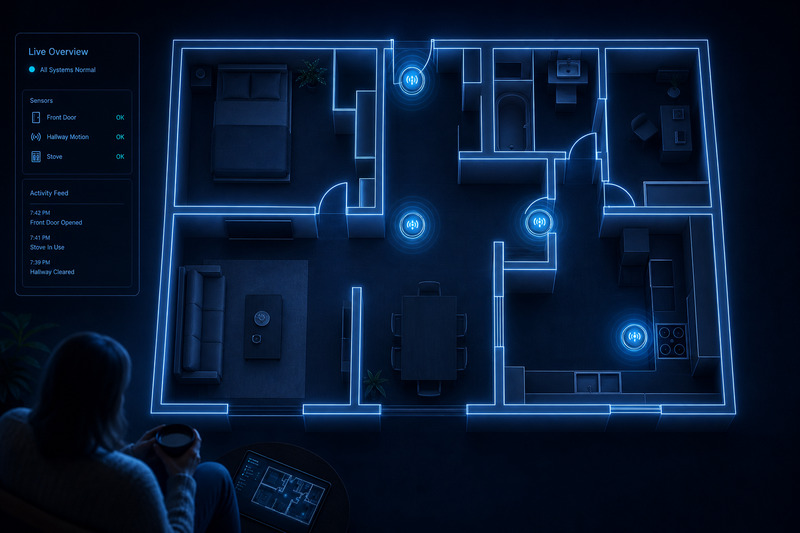
Smart home devices for the elderly with dementia address this specific exhaustion by operating silently in the background.
This passive safety layer includes automatic stove shut-off devices that prevent fire risks without restricting a parent’s cooking routines.
Door and window sensors alert caregivers when exterior doors open during unusual hours, providing early notice of a potential nighttime exit.
Motion-activated night lights reduce fall risks during late-night bathroom trips, eliminating the cognitive confusion of locating a switch.
This technology fundamentally removes the constant background vigilance of wondering what might happen when you look away.
While some fixtures do require an afternoon of installation, the system operates completely independently once in place.
They do not replace supervision for complex emergencies, but they dramatically reduce indoor environmental risks.
3. Reliable Automated Medication Management Systems
Medication mismanagement, whether it is a missed dose or a double dose, is the most common preventable crisis in at-home dementia care. It is also one of the most frequent triggers for emergency room visits.
Handwritten medication charts and verbal reminders depend heavily on memory and initiative. Both of these faculties decline progressively and unevenly during cognitive decline.
When evaluating technology to help aging parents, medication management usually falls into two sub-levels matched to the disease stage.
App-based reminders are highly effective for earlier stages, where the individual can still respond to a prompt and take action.
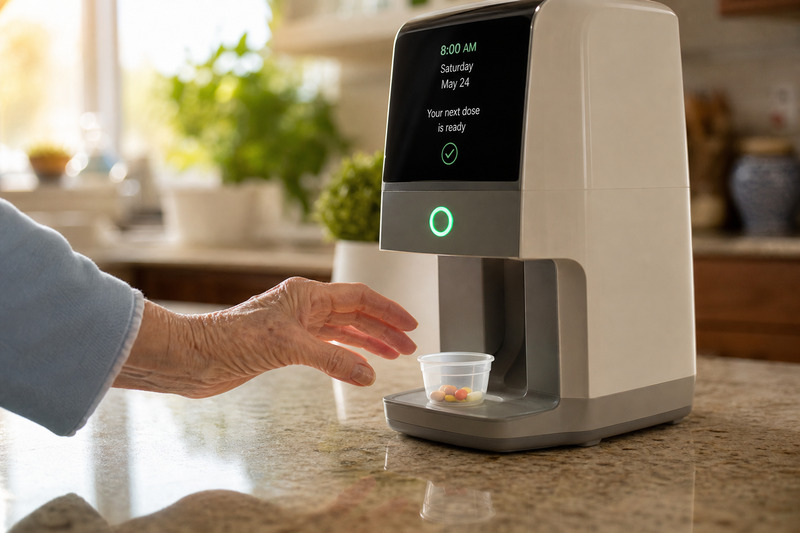
For later stages, automated pill dispensers offer a more robust solution.
These devices are pre-loaded monthly, dispense the correct dose at the exact scheduled time, and lock access to all subsequent doses.
This removes both the complex decision-making and the emotional negotiation from medication time.
Setup requires an afternoon of careful sorting each month and close coordination with a pharmacist for any prescription changes.
While automated dispensers cannot manage complex medication changes without manual reloading, the ongoing crisis prevention value is profound.
| Important: Medication mismanagement is the most common preventable crisis in at-home dementia care and a frequent trigger for emergency room visits. A handwritten chart cannot compensate for progressive memory decline. |
4. Helpful Video Calling Check-In Devices
Every caregiver knows the mid-afternoon worry that prompts a drive across town just to confirm that a parent is safe.
This anxious commuting is one of the most time-consuming and emotionally costly patterns in active caregiving.
Video calling is not simply a social nicety; it is a critical caregiver anxiety management tool.
Purpose-built senior video tools differ significantly from standard smartphone apps.
Large-screen devices equipped with auto-answer capability allow the loved one to simply look up and talk.
There is no button pressing and absolutely zero cognitive demand placed on them. A visual check-in provides what a voice call simply cannot by revealing body language and facial expressions.
This reduces between-visit anxiety dramatically, allowing caregivers to maintain a daily face-to-face connection without daily driving.
Auto-answer devices do require a reliable internet connection and a brief acclimation period, but the transition is usually gentle.
They cannot replace hands-on care or independently detect medical emergencies, but as a connection tool, they are invaluable.
| Pro Tip: Reframe video calling as a caregiver anxiety management tool, not just a social check-in. Seeing body language and environment tells you what a voice call cannot. |
The Bottom Line
Technology cannot replace a caregiver’s love, judgment, or physical presence. The best tools available today have never claimed to replace human interaction.
What the right technologies replace is the relentless background vigilance that exhausts caregivers the most.
They relieve the constant alertness that makes genuine presence feel impossible.
When a GPS watch handles location awareness, and a sensor watches the stove, the caregiver reclaims something essential.
You do not gain freedom from the role, but rather the ability to inhabit it fully as a family member rather than a security system.
Freeing that energy for genuine connection is perhaps the most meaningful thing a piece of technology can do.
| Author Profile: Tranquil is the leading manufacturer and retailer of high-end GPS locator watches for elderly individuals and those with dementia. |

Ellen is a busy mom of a 29-year-old son and 33-year-old daughter. She owns nine blogs and is addicted to social media. She believes that it doesn’t have to be difficult to lead a healthy life. She shares simple healthy living tips to show busy women how to lead fulfilling lives. If you’d like to work together, email info@confessionsofanover-workedmom.com to chat.
