
Last Updated on November 4, 2026 by Ellen Christian
Most families buy an air purifier with a specific problem in mind: a stuffy nursery, a dog that sheds year-round, a kid with spring allergies, or a smoky week in August. Then the box arrives, and it barely makes a dent in the room it was bought for.
Posts may be sponsored. This post contains affiliate links, which means I will make a commission at no extra cost to you should you click through and make a purchase. As an Amazon Associate I earn from qualifying purchases.
Usually the machine is too small for the space. Getting the size right comes down to one number on the box and a tape measure.
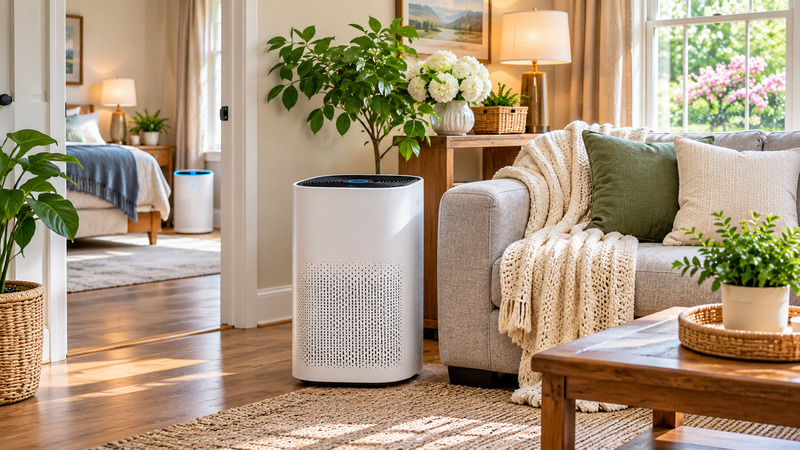
How Air Purifier Size Is Measured
The number to look for is CADR, short for Clean Air Delivery Rate. It tells you how many cubic feet of filtered air a purifier puts out per minute, measured on its highest setting.
Most boxes list three CADR figures: one for smoke, one for dust, and one for pollen. Use the smoke number when you compare models. Smoke particles are the smallest and hardest to catch, so it’s the most conservative of the three.
The Association of Home Appliance Manufacturers (AHAM), which runs the CADR testing program, bases its room-size suggestions on a simple formula. Multiply the smoke CADR by 1.55 and you get the square footage the purifier can handle in a room with 8-foot ceilings.
Working backward is easier when you’re shopping:
- Measure the room’s length and width, then multiply them for square footage.
- Divide that number by 1.55.
- The result is the minimum smoke CADR you want.
That formula assumes the purifier cleans the room’s air about 4.8 times an hour, which is a reasonable everyday target. For wildfire smoke, AHAM suggests a stronger standard: a smoke CADR equal to the room’s full square footage.
Adjust for High Ceilings
Older farmhouses and new builds alike often have ceilings above 8 feet, and that extra height means more air to clean. A quick fix is to bump your square footage up before you do the math.
For 9-foot ceilings, multiply the floor area by 1.125. For 10-foot ceilings, multiply by 1.25. A vaulted family room might need a purifier rated for a space half again as large as the floor plan suggests.
According to the Association of Home Appliance Manufacturers (AHAM), choosing an air purifier with the appropriate Clean Air Delivery Rate (CADR) for your room size is essential for effective air cleaning.
Room-by-Room Sizing for Family Homes
Here’s how the formula plays out in the rooms where families spend the most time. All numbers assume 8-foot ceilings, so adjust if yours are taller.
Nursery or Small Kids’ Room
A 10-by-10 nursery is 100 square feet, which works out to a smoke CADR of about 65. Plenty of compact purifiers hit that number.
Noise matters more here than anywhere else in the house. A purifier rated for a bigger room can run on its quiet setting and still keep up, which is better than a small one roaring on high next to the crib.
Children’s Bedroom or Shared Room
A 12-by-12 bedroom comes to 144 square feet, so aim for a smoke CADR of at least 93. If two kids share a 12-by-14 room, you’re at 168 square feet and a CADR around 108.
Kids’ rooms collect dust fast between stuffed animals, carpet, and piles of laundry. If your child has allergies, a common move is to size up one step so the purifier can run quietly overnight without falling behind.
Primary Bedroom
Primary bedrooms in many family homes run 14 by 16 feet, or 224 square feet. That calls for a smoke CADR of roughly 145.
You spend about a third of your day in this room, and most of that time the door is closed. That makes it one of the easiest rooms to clean effectively, since the purifier isn’t competing with air drifting in from the rest of the house.
Living Room or Family Room
A 16-by-20 living room is 320 square feet, which needs a smoke CADR of about 206. This is where pet hair, cooking smells, and the dust kicked up by kids and dogs all collect.
Living rooms are also where people most often undersize. A purifier that looks big enough on the shelf often turns out to be rated for a bedroom.
Open-Concept Kitchen and Living Space
Open floor plans are tricky because the air doesn’t stop at the edge of the rug. Measure the whole connected space. A 500-square-foot open kitchen and living area needs a smoke CADR around 323.
That’s a high number for one machine. Two mid-size purifiers placed at opposite ends often clean the space more evenly than a single large unit in a corner.
Basement Playroom or Home Office
Finished basements can feel damp and stale, especially in older houses. A 300-square-foot playroom needs a smoke CADR around 194.
Basement ceilings are often lower than 8 feet, which works in your favor. Less volume means a slightly smaller purifier can keep up. A home office around 120 square feet needs a CADR near 77.
What Changes the Math
The formula gets you close, but a few household details push the number up.
Pets. Dogs and cats shed dander and hair all day. Sizing up one step gives the purifier room to handle the extra load.
Smoke and wildfire season. If you live where wildfire smoke drifts in, use the stronger standard: smoke CADR equal to the square footage.
How loud you can tolerate it. CADR is tested at top speed, and almost nobody runs a purifier on high all day. If you’ll keep it on low or sleep mode, buy a model rated for more space than you have.
Doors and drafts. A purifier sized for a bedroom only works at that size with the door mostly closed. Leave it open to a hallway, and the machine is now trying to clean the hallway too.
Placement and Upkeep Matter as Much as Size
A correctly sized purifier can still underperform if it’s tucked behind a dresser. Give it a foot or two of open space on all sides so it can pull air in and push it back out.
Filters are the other half of the job. A clogged HEPA filter slows airflow, which lowers the purifier’s real-world CADR. Check the manufacturer’s replacement schedule and set a phone reminder, because filters are easy to forget once the machine fades into the background.
When you’re comparing models, it helps to look for brands that sell the same purifier in more than one size. AirOasis, for example, offers its iAdaptAir purifier in three sizes, so you can match a smaller unit to a nursery and a larger one to the family room without learning a new set of controls.
Choosing the right air purifier is just one way to create a healthier, more comfortable living space, so explore these whole-home comfort solutions for additional ways to improve air quality and everyday comfort.
The Number to Write on Your Shopping List
Before you buy, walk through the house with a tape measure and write down the square footage of each room you want to cover. Divide each one by 1.55, adjust for tall ceilings, and that’s the smallest smoke CADR worth buying for that room.
Then size up if you have pets, allergies, or wildfire smoke in your area, or if the purifier will run on its quiet setting. The model that matches your room on paper and can still run quietly at night is the one to put in the cart.
Helpful Air Purifier Essentials
Choosing the right air purifier is just the beginning. These helpful products can make it easier to maintain cleaner indoor air throughout your home.
- Replacement HEPA Filters – Help keep compatible air purifiers working efficiently.
- Indoor Air Quality Monitor – Track certain airborne pollutants in your home.

Ellen is a busy mom of a 29-year-old son and 33-year-old daughter. She owns nine blogs and is addicted to social media. She believes that it doesn’t have to be difficult to lead a healthy life. She shares simple healthy living tips to show busy women how to lead fulfilling lives. If you’d like to work together, email info@confessionsofanover-workedmom.com to chat.
