
Last Updated on July 23, 2026 by Ellen Christian
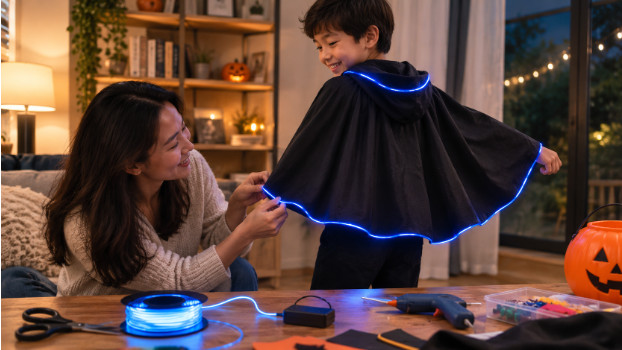
One parent stitched glowing blue EL wire along the hem of their child’s Halloween cape, and most people assumed it had been professionally made or rented. In reality, it only took an inexpensive spool of EL wire, a small AA battery pack hidden inside a pocket, and about twenty minutes of work. That’s what surprises most DIYers. The barrier to entry is much lower than they expect.
Posts may be sponsored. This post contains affiliate links, which means I will make a commission at no extra cost to you should you click through and make a purchase. As an Amazon Associate I earn from qualifying purchases.
If you’ve got a craft drawer, a hot glue gun, and a project that feels a little flat, this is probably the easiest upgrade available to you.
What El Wire Actually Is
Strip it down and el wire is just a copper core dusted with phosphor, wound with a couple of hair-thin wires, and sheathed in colored plastic. Feed it alternating current and the whole strand lights at once. No bulbs, no hot spots, no individual diodes, just a continuous line of glow.
It’s the same principle behind electroluminescent displays, which have been around since the 1930s. What changed is that the driver hardware got cheap and pocket-sized.
Two practical things follow from how it works. One, it barely warms up, so sewing it straight onto fabric is fine. Two, it bends happily but hates a hard crease. Crimp it once, and the phosphor cracks, and that dead patch stays dead.
Projects Worth Starting With
Costumes are where most people start. Trace the seams of a jacket, outline a mask, run a line down each pant leg, and your outline suddenly reads from the other side of a dark room. Festival regulars have been doing this for years.
Home decor is where it gets more interesting. Tuck a strand behind a floating shelf and you get a soft wash of color on the wall. Run it under a bed frame, and it doubles as a nightlight nobody wakes up to. It can also be wound around a bare branch in a vase and it looked far better than it had any right to.
Then there’s the kid-project category:
- Bike frames and helmets for evening rides
- Backpack outlines for the walk home in winter
- Science fair displays that need to stand out on a crowded table
- Sports team signs for night games
That last one is a favorite. If you’re already deep in the kids’ craft project rabbit hole, adding a glowing element to something they’ve built themselves tends to keep them interested for longer.
Working With It Without Frustrating Yourself
A few things we wish someone had told us earlier:
Buy more length than you think you need. Curves eat wire fast, and there’s no clean way to splice two pieces together mid-project. Lay out the path with string first, measure that, then add a third on top.
Where you can, use small stitches, clear fishing line, or fabric tape instead of glue. Hot glue holds fine, but it also welds the EL wire in place forever, which you’ll regret the day a section dies. Wood or plastic surfaces? Little cable clips.
Plan for the inverter. It’s the little box that converts battery power to the AC the wire needs, and it hums faintly. Hide it in a pocket, a hem, or behind a picture frame, but keep it reachable, because you’ll want to swap batteries.
Choose color with the setting in mind. Aqua and green read brightest to the human eye, which matters for visibility at night. Purple and red look richer up close but disappear faster at a distance. For a costume photographed indoors, that tradeoff barely matters. But for a bike, it matters a lot.

Cheap Wire vs. Wire That Lasts
Bargain EL wire usually dies one of two ways. The solder joint at the connector lets go, or the sleeving’s thin enough that one bad bend kills a whole run. Either way, you find out at the worst possible moment.
Look for reinforced connectors and sleeving thick enough that it holds a curve without kinking. GloFX has EL wires in a range of colors and lengths built for repeated use rather than one-night use, worth a look if you’d rather not redo the project next season. (You can also see other accessories that pair well with it here.)
A Note on Batteries and Longevity
A standard two-AA inverter runs a few meters of EL wire for roughly ten to fifteen hours of continuous use, depending on length and whether you’re running steady or flashing mode. Flashing extends runtime, though it’s noticeably more distracting to look at.
The EL wire itself dims gradually over thousands of hours. You won’t hit that in a costume, but a permanent installation will slowly fade over a couple of years. Something to keep in mind before you glue a strand behind a mirror you never plan to take down.
Start Small
Grab a three-meter length of EL wire and put it on something you’ve already made. A photo frame, a sign, an old jacket. Seeing it light up in a dark room does more to spark project ideas than any tutorial will, and once you’ve handled the stuff once, the bigger builds stop feeling complicated.
If you’re hunting for a starting point, there’s usually something in the seasonal DIY roundups that takes well to a little glow.

Ellen is a busy mom of a 29-year-old son and 33-year-old daughter. She owns nine blogs and is addicted to social media. She believes that it doesn’t have to be difficult to lead a healthy life. She shares simple healthy living tips to show busy women how to lead fulfilling lives. If you’d like to work together, email info@confessionsofanover-workedmom.com to chat.
