
Last Updated on September 23, 2026 by Ellen Christian
There is a good chance something is hanging in your shower right now that you stopped noticing months ago. Maybe it is a loofah, maybe one of those puffy plastic scrubbers, maybe a long stretchy net that came in a gift set. It does its job quietly, and you have probably never stopped to ask whether it is the right one for your skin.
Posts may be sponsored. This post contains affiliate links, which means I will make a commission at no extra cost to you should you click through and make a purchase. As an Amazon Associate I earn from qualifying purchases.
The question of which one exfoliates better comes up constantly, and the answers online tend to be louder than they are useful. Part of the problem is that three genuinely different tools keep getting filed under the same name. Sorting that out first makes the rest of the comparison a lot easier.
So what is the actual difference between them?
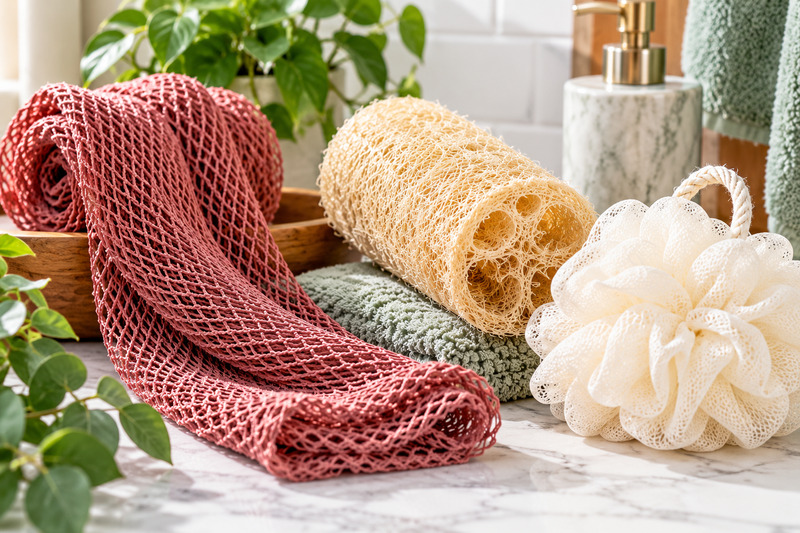
A natural loofah, sometimes spelled luffa, is not a sea sponge at all. It is the dried fibrous interior of a gourd, which is why it feels stiff and almost woody when dry and softens once you soak it.
A synthetic bath pouf is a different thing entirely. It is a long strip of plastic mesh gathered and tied into a ball, which is why it feels airy against skin and whips up so much lather from so little body wash.
An African net sponge is a third category. It is a long piece of open-weave synthetic mesh, flat and looped rather than bunched, designed to be held at both ends and worked across the body.
How do the textures compare?
These three do not sit on one scale running from gentle to aggressive. They feel different because they are built differently, and that changes how much say you have in the result.
A natural luffa has a relatively fixed texture. Its coarseness is whatever the dried plant fiber happens to give you, so your only real adjustment is pressing harder or easing off.
A bath pouf has a softer, more bunched construction than the other two. Its mesh is particularly effective at building lather, while offering a different type of physical exfoliation from a natural luffa or flat net.
An open net behaves differently again. Because it is flat and stretchy, the texture depends on how taut you pull it and how much pressure you apply, so the same net can feel light across your shins and firmer on your heels.
None of that makes one of them the superior exfoliator. Rougher is not automatically better, and a tool that gives you more control over pressure is not necessarily less effective for your routine.
Which one can you actually use on your back?
This is the practical difference most people notice first. A gourd loofah is a rigid block and a pouf is a ball, and neither shape does much for the middle of your back.
A long flat net does, because you can hold one end in each hand and draw it across. Kitsch makes an african net sponge from 70% recycled nylon and 30% recycled polyester, using a long, stretchable mesh design that can be pulled between both hands to reach across the back. Its Rosewood version comes three to a package.
That is a construction difference, not a verdict. If reaching your back has never been a problem for you, it may not matter much either way.
RELATED: Lemon Poppy Seed Soap to Exfoliate
How fast does each one dry?
Drying is where the real hygiene conversation lives, and it applies to all three. Cleveland Clinic dermatologist Melissa Piliang, MD, has explained that loofahs are used in a wet environment and then hung in a wet environment, so they never fully dry out, which makes them a welcoming home for bacteria.
Her advice has more to do with where you keep it than what it is made of. Shake it out after use, hang it somewhere cool outside the shower, and throw out anything that develops mold or a musty smell.
Construction does affect drying. An open-weave net holds less water than a dense natural loofah or a bunched bath pouf and can dry more readily when it is rinsed and hung in a well-ventilated place.
That is a physical difference, not a health claim. Rinsing properly, drying properly and replacing the thing on time matter whichever of the three is hanging in your shower.
How often do you have to clean and replace them?
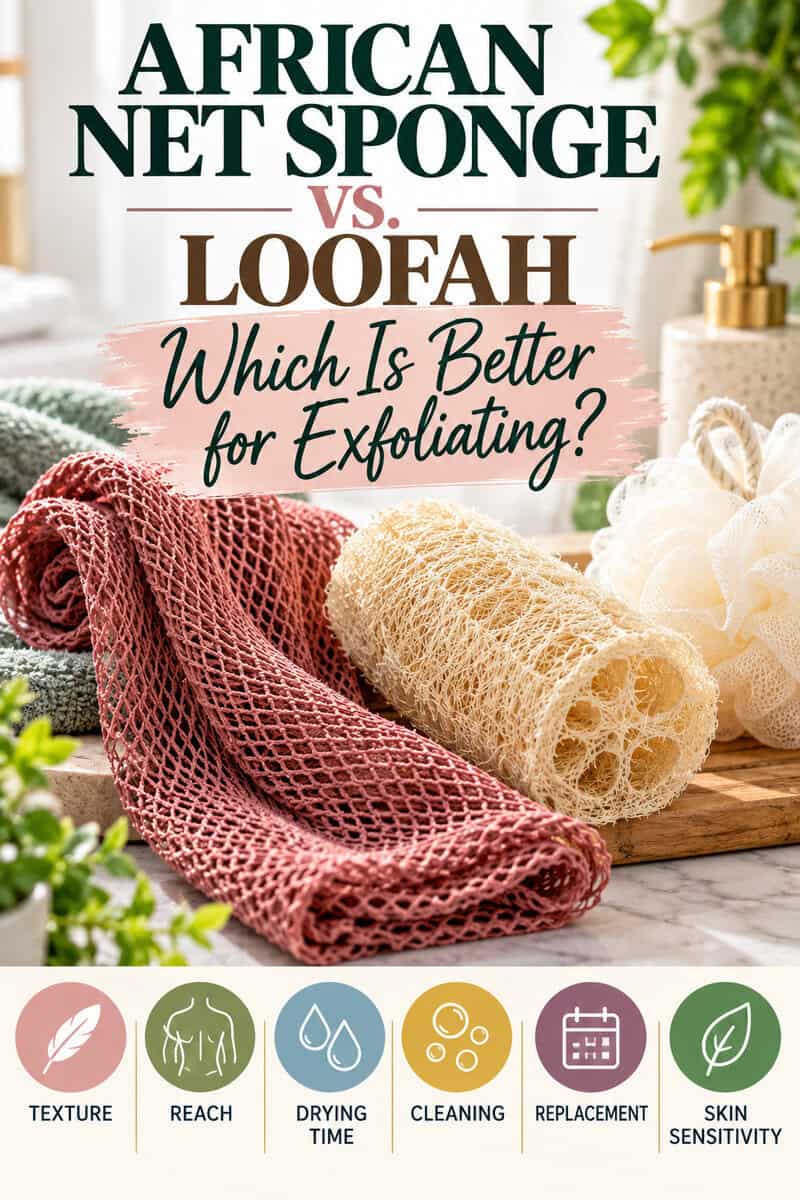
Cleveland Clinic’s guidance for loofahs is specific. Clean them weekly, replace a natural loofah every three to four weeks and a plastic one every two months, and discard any of them at the first sign of mold or a mildewy odor.
Care instructions for net sponges come from the manufacturer and should not be stretched across a whole category. Kitsch, for instance, says to rinse its net after each use and hang it in a well-ventilated area to dry, to hand wash and air dry it rather than putting it in the machine, and to replace it every three to six months.
The useful habit here is checking what came with the packaging rather than assuming. Materials differ, and one product’s replacement window is not a rule for every net sponge on the shelf.
Is any of this too rough for your skin?
Physical exfoliation works by loosening and lifting surface dead skin cells, and not every skin type wants that. The American Academy of Dermatology notes that people with dry, sensitive or acne-prone skin may prefer a washcloth and a mild chemical exfoliator, since mechanical exfoliation can be too irritating.
The AAD is also clear that you should never exfoliate over open cuts, wounds or sunburned skin, and that short light strokes beat pressure. Freshly shaved legs are worth leaving alone for a few days as well.
There is no schedule that fits everyone. The AAD’s general principle is that the more aggressive the exfoliation, the less often it needs to happen, and skin that turns red and irritated is telling you it was too much.
So which one exfoliates better?
Neither, in any universal sense. A natural loofah gives you a fixed coarse texture, a bath pouf gives you softness and lather, and an open net gives you control over pressure and reach. They are not three versions of the same tool ranked from worst to best.
The right one for you comes down to the texture you actually enjoy, how much your skin tolerates, whether reach is a problem worth solving, and how realistic you are about rinsing, drying and replacing it. Whichever one you choose, rinsing it well, letting it dry properly and replacing it when needed are just as important as the format itself.

Ellen is a busy mom of a 29-year-old son and 33-year-old daughter. She owns nine blogs and is addicted to social media. She believes that it doesn’t have to be difficult to lead a healthy life. She shares simple healthy living tips to show busy women how to lead fulfilling lives. If you’d like to work together, email info@confessionsofanover-workedmom.com to chat.
