
Last Updated on March 30, 2026 by Ellen Christian
You’ve reorganized the living room. Bought new throw pillows. Maybe repainted a wall or two. The house is cleaner than it was, and on a good day it’s even tidy. But there’s still something off. The walls feel blank and anonymous, like a hotel room that has nothing to do with you. Sound familiar?
Posts may be sponsored. This post contains affiliate links, which means I will make a commission at no extra cost to you should you click through and make a purchase. As an Amazon Associate I earn from qualifying purchases.
I think a lot of us get so focused on managing the chaos – the laundry, the schedules, the never-ending to-do list – that we forget the home is supposed to feel like us. Not just functional. Ours. And one of the fastest ways to fix that feeling isn’t a new furniture arrangement or another storage basket. It’s putting original art on the wall. One piece. The right piece. It changes the room in a way that’s genuinely hard to explain until you’ve experienced it.
What Science Says About Art and Your Stress Levels
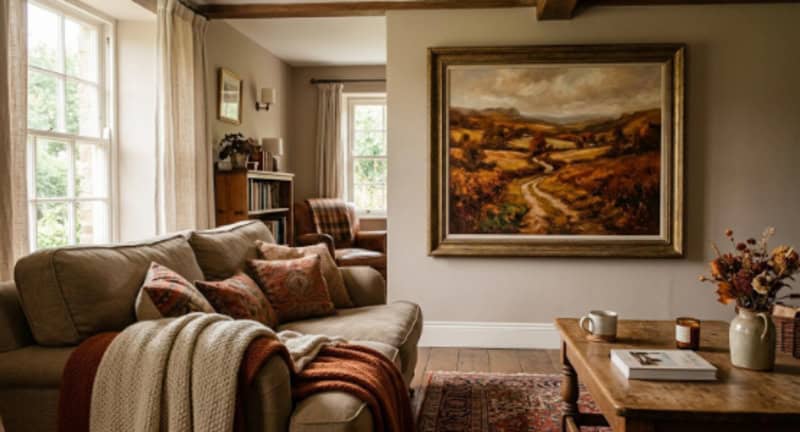
A single original painting can anchor a room and shift the entire emotional tone of the space.
This might sound like it’s leading to an expensive sales pitch. It’s not. Because the science here is pretty striking, and it matters for anyone who’s already doing everything right – eating well, trying to sleep enough, getting outside – but still feels like their stress baseline is just too high.
A 2025 King’s College London study, co-funded by Art Fund, found that viewing original art reduced cortisol levels by 22%. Cortisol is your primary stress hormone. The same study found that pro-inflammatory markers, specifically cytokines IL-6 and TNF-α, dropped by 30% and 28%, respectively, in the group viewing original artwork. Those are the markers associated with chronic inflammation and long-term disease risk. The key detail? The reproduction group saw only an 8% cortisol drop – and no meaningful change in the inflammatory markers at all.
That gap between original and reproduced art isn’t trivial. The Museums Association reported on this research in October 2025, and the implications are hard to ignore: the actual physical object, made by human hands, does something to our nervous system that a print copy simply doesn’t replicate.
The APA reported in 2025 that repeated exposure to art engages multiple sensory and cognitive systems at once, creating a kind of mental “reset” that’s difficult to get from other passive activities like scrolling or watching TV. Your brain responds to the texture, the scale, the sense of presence that a real painting carries.
If you’re at the point where you’d try almost anything to bring a bit more calm into your home environment, this is worth taking seriously. And you don’t need a gallery or a five-figure budget to do it. If you’re looking for original oil paintings that won’t require a gallery budget, Art by Maudsch offers handmade pieces you can browse and buy online – no appointment, no pressure, no intimidating white walls.
Original Art vs. a Print: Does It Really Matter?
Budget-conscious moms will ask this question, and they should. Prints are cheaper. They’re easier to find. They won’t arrive rolled in a tube and require you to figure out framing. So what’s the actual difference?
The cortisol data from King’s College London gives us a concrete answer: 22% stress reduction for originals versus 8% for reproductions. That’s not a rounding error. The Museums Association covered this research in depth, and researchers believe the gap comes from how the visual system responds to physical texture, brushstroke variation, and the perceptual knowledge that a human being made this specific object. A print is a photograph of a painting. Your brain processes it differently, even if you’re not consciously thinking about that.
None of this means a beautiful print is worthless. It’s still better than a blank wall. But if you’re making one intentional home purchase this year and you want it to actually do something for how you feel in your space, an original is where the return on investment is.
Here’s the thing most people assume wrong: original art doesn’t have to mean expensive art. The Art Basel and UBS Global Art Market Report 2026 found that 61% of collectors prefer works priced under $5,000, and smaller works from independent artists regularly sell in the $200 to $800 range. That’s a couch pillow upgrade budget. It’s a rug budget. But a painting lasts decades.
The same attention you might give to your front yard decorating ideas – making the outside of your home feel intentional and personal – deserves to come indoors, too. Your walls are the backdrop of your daily life. They’re worth thinking about.

How to Choose the Right Painting for Your Home
Shopping for original art online means you can browse from home at your own pace, without gallery pressure.
This is where people get stuck. They love the idea of buying original art, they find a piece they like, and then they second-guess themselves for two weeks. Here’s a practical framework that actually helps.
●Start with your light. Oil paintings with warm tones – ochres, burnt siennas, soft greens – work well in most traditionally styled country homes because they play well with natural wood and warm artificial lighting. If your living room gets cool northern light, you actually want warmer colors on the walls even more.
●Buy what stops you. Not what “matches the couch.” Not what your neighbor would approve of. When you’re scrolling through an artist’s collection online, and one piece makes you pause – that’s your answer. Research from 2025 at King’s College London found that art’s stress-reduction effects were universal across personality types and levels of art knowledge. You don’t need to understand art to benefit from it. You just need to respond to it.
●Think scale. One larger piece – 24 x 30 inches or bigger – has more presence and psychological impact than a cluster of small prints. It creates a focal point. The room gets organized around it.
●Shop independent artists. Lower overhead means lower prices. You’re also buying something with a story – a real person’s creative work – which adds meaning that a mass-produced canvas print simply can’t carry. For the same reason people value a DIY desert terrarium over a plastic plant, handcrafted and nature-inspired pieces bring a different kind of warmth to a room. There’s a specific pleasure in knowing something was made rather than manufactured.
Bringing It All Together: Art as a Daily Reset
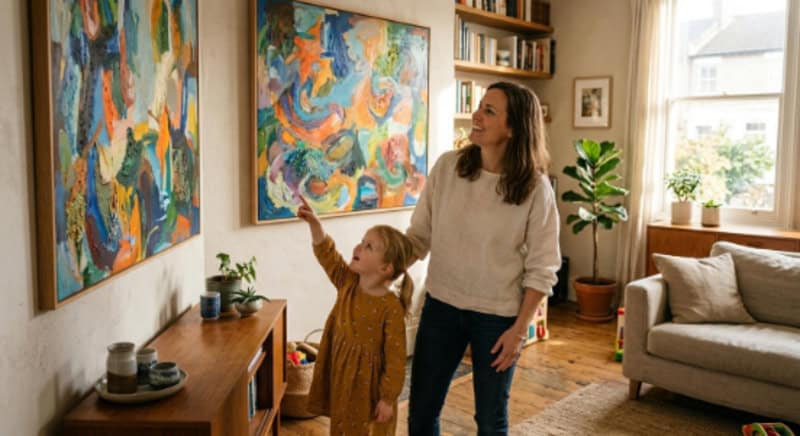
Original art becomes part of your family’s daily backdrop – something your kids will remember long after childhood.
Your home is where you start every morning and land every evening. The visual environment you live inside isn’t something you consciously notice most of the time, but it’s working on you constantly. The cluttered corner that always catches your eye. The cold, blank wall in the hallway. The room that never quite feels like it belongs to you. These things add up.
A 2025 study published in Frontiers in Psychology found that regular art engagement reduced average psychological distress scores by 5.33 points and anxiety scores by 2.66 points, specifically in participants aged 41 to 60. That’s the study’s data – not a vague claim, but a measured reduction in real clinical anxiety markers. And that age range? It’s us. It’s the exact audience that needs this most.
One original painting on your wall isn’t going to fix everything. But it becomes a daily visual cue – a small, quiet reminder that beauty and calm belong in your life even on the hardest days. That’s nothing. That’s actually a lot. There’s something similar going on with any creative or handmade thing you choose to bring into your home. When you decide to paint a ceramic flower pot or pick out an original piece of art, you’re expressing the same instinct: that the things around you should carry meaning. Your home should reflect who you are, not just who you’re trying to keep organized.
One Change That Actually Lasts
Most home upgrades are temporary. Pillows fade. Trendy paint colors look dated in five years. Furniture wears out or goes out of style. An original painting doesn’t work that way. It retains its meaning and beauty for decades and becomes part of your family’s story.
Your kids will grow up looking at it. It’ll be in the background of birthday photos. Someday it might mean something to someone who never even knew you bought it on a quiet afternoon when you finally decided your walls deserved better.
You don’t need a gallery. You don’t need a big budget, an art history degree, or anyone’s approval. You just need one piece that speaks to you. That’s the whole thing.
According to Fortune Business Insights, the global wall art market was valued at $66.89 billion in 2025, with North America accounting for nearly 44% of that demand. People are buying art for their homes at record rates. They’ve figured something out. You can too.

Ellen is a busy mom of a 29-year-old son and 33-year-old daughter. She owns nine blogs and is addicted to social media. She believes that it doesn’t have to be difficult to lead a healthy life. She shares simple healthy living tips to show busy women how to lead fulfilling lives. If you’d like to work together, email info@confessionsofanover-workedmom.com to chat.
